Showing posts with label Education. Show all posts

Wednesday, October 23, 2013

Adjust WB on 40D


[1] http://www.dpreview.com/forums/thread/2284675#forum-post-27416922


First, get it as close as you can using custom white balance.
1. Get a white card or a piece of white poster board.
2. Prop it up where your subject will sit.
3. Take an out-of-focus picture of it (be sure to fill the frame with the white card).
4. In your 40D's menu, find the "Custom White Balance" setting.
5. Select the picture you just took.
Now your white balance setting will be very close to reality, if not actually spot-on. Next, shoot RAW quality. In your RAW conversion software of choice (probably DPP, which came with your camera), use the eye-dropper to set your white balance. The white of your subject's eye is usually an excellent WB reference point. Teeth are usually yellowish, making them a very bad reference point.

Monday, September 23, 2013

Plumbing --- Plumber Tape Teflon Tape for Thread seal


Ref [1] Family Handyman


Use two types of Teflon on threaded joints

« Previous Photo
Connections that rely on threaded pipes and fittings are prone to leaks if they're not sealed with either Teflon tape or Teflon pipe joint compound. Careful plumbers use both on every joint for extra security. They don't want to come back.
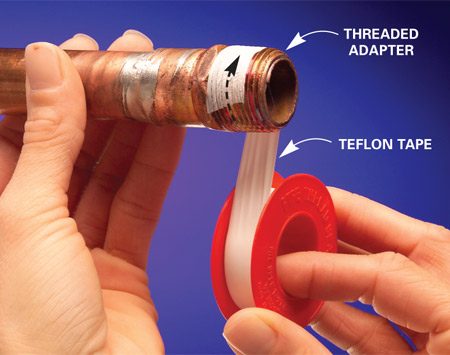
Start by wrapping the male threads with Teflon tape (Photo 1). With the end of the threaded pipe facing you as shown, wrap the tape clockwise. Usually three layers is enough. Once in a while, you'll run into a loose fitting that requires four or five wraps. Stretch and tear the tape to complete the wrap.
Spread a thin layer of Teflon pipe joint compound over the tape (Photo 2). If you're working with plastic pipe, choose Teflon pipe joint compound that's compatible with it. Then start the threads by hand before tightening the connection with wrenches (Photo 3). Wipe away the excess.

Lubricate the ferrule on compression joints

« Previous Photo
Compression joints are most common on shutoff valves, although you find them on other fittings as well. They have a brass or plastic ring (ferrule) that's compressed into a recess when you tighten the nut, forming a seal. Lubricating the pipe and the ferrule with a bit of Teflon pipe joint compound (Photo 1) helps the ferrule slide along the pipe and squeeze tightly into the recessed fitting with less wrench pressure (Photo 2). Tighten compression fittings firmly with two wrenches to crimp the ferrule onto the pipe (Photo 3). Also make sure the pipe or tube goes straight into the fitting. Misalignment will cause a leak. If the fitting leaks after you turn on the water, try tightening the nut an additional one-quarter turn. This usually stops the leak.

Align slip joints precisely for a tight seal

« Previous Photo
Joints on chrome trap assemblies rely on rubber slip joint washers for the seal, which often leak. If you're reassembling a chrome trap, buy new slip joint washers and nuts. However, new washers sometimes stick to the pipe, causing them to twist or distort as you push them tight with the slip joint nut. To avoid this, lubricate the drain tubing and slip joint with a little pipe joint compound (Photo 1). The compound helps the washer slide smoothly and creates a tighter seal.
Start the slip joint nut by hand, and twist it on until the threads are engaged correctly. Hand-tighten all joints first (Photo 2). Then adjust the trap parts until they're aligned and pitched slightly for drainage. This is key; a misaligned joint will leak, even with new washers. Finally, use a large slip joint pliers to tighten the nuts an additional half turn.
Plastic trap parts use hard plastic slip joint washers for a seal. Make sure the flat part is against the nut with the tapered side facing the fitting.

Choose flexible supply tubes

Next Photo »
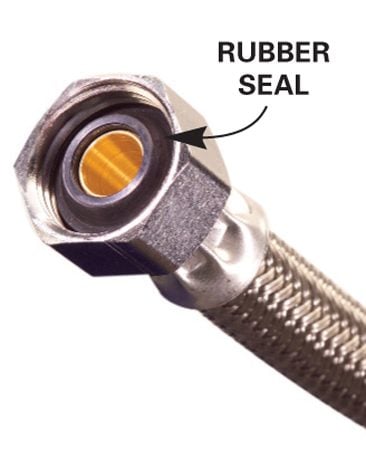
The skinny copper or chrome supply tubes used to connect faucets and toilets (Photo 1) are tricky to cut, bend and align. But you don't have to put up with them. When you're replacing a faucet or toilet, use flexible supply hoses with a braided covering instead (Photo 2). They have rubber gaskets at each end and don't require much force to seal. They're available in many lengths and are flexible enough to fit almost any configuration. The only trick is buying a connector with the correct size nuts on the ends. Take your old tubing and the nuts on each end along with you to the store to be sure of an exact match.
Start the nuts carefully and hand-tighten. Then tighten an additional half turn (Photo 2). Avoid overtightening. It's easy to tighten the nuts a little more if the joint leaks.

Electrical Wiring Colour


Ref [1]  http://www.accesscomms.com.au/reference/powerplug.htm
Ref [2] http://en.wikipedia.org/wiki/Electrical_wiring_in_the_United_Kingdom

According to [2]
Pre-1977 IEEPre-2004 IEECurrent IEC
Protective earth (PE)Color wire green.svgColor wire green yellow.svgColor wire green yellow.svg
Neutral (N)Color wire black.svgColor wire black.svgColor wire blue.svg
Single phase: Line (L)Color wire red.svgColor wire red.svgColor wire brown.svg
Three-phase: L1Color wire red.svgColor wire red.svgColor wire brown.svg
Three-phase: L2Color wire yellow.svgColor wire yellow.svgColor wire black.svg
Three-phase: L3Color wire blue.svgColor wire blue.svgColor wire grey.svg

According to [1]

Australian 3-Pin Electrical Mains Plug

The domestic mains power supply in Australia is 240V AC, 50Hz. Standard 3-pin earthed power outlets are rated at 10Amps and are usually switched. The 3-flat-pin plug is used in all states of Australia (including its external territories), New Zealand, Papua New Guinea and the Solomon Islands.  Although the configuration is similar to mains plugs used in mainland China, dimensional differences to the plug body may be incompatible with recessed cord socket and prevent Chinese-compliant CPCS/CCC (CCEE) plugs from being legally sold/used in Australia.  Argentina also uses a similar 3-flat-pin configuration as Australia, but with slight dimensional differences and with the active and neutral wires being reversed. These important differences prevent the Argentina-compliant IRAM plugs from being legally sold/used in Australia as incorrect polarity may present an electrical safety hazard.
The Australian mains plug configuration was originally presented as provisional standard C112 in 1937, formalised as Standard C112 in 1938, redesignated AS3112 in 1981 and harmonized with the New Zealand standard and redesignated AS/NZS3112 in 1993.  Australian Standards AS/NZS 3112:2000 and AS/NZS3112:2004 for Australian Mains Plugs now define the requirements for theinsulation of the Active and Neutral pins of the plug.  15Amp and 20Ampconfigurations of the mains plug and outlet are also defined by the standard.
The following diagram shows the Australian plug wiring configuration.
australian 3 pin wall socket for 240 volt ac power distribution Australian 3 Pin Mains Plug 240V AC
The diagrams below show wiring for an Australian 240V mains cord plug and socket. Note the "reversal" of the Active and Neutral wires depending on whether you are wiring a socket or a plug.
Australian 240V mains socket wiring Australian 240V mains power plug wiring

Standard wire colors are:

MarkingFlex conductor colorsBuilding wire conductor colors
ActiveABrownRed
NeutralNBlueBlack
EarthEGreen/YellowGreen/Yellow

Older flex and premises wiring will use the following colors:

MarkingFlex conductor colorsBuilding wire conductor colors
ActiveARedRed
NeutralNBlackBlack
EarthEGreenGreen
Check out our extensive range of Power cords, AC adaptors, In-line switch mode power supply units and Power components from our on-line catalog.

Tuesday, April 23, 2013

How to find out MSISDN and IMSI?


From: http://www.tomshardware.com/forum/33509-39-finding-msisdn-number


IMSI

MSISDN


> What are the currently used ways of finding the 'own' MSISDN?

The MSISDN can be stored on the SIM. It's often put there by
the network provider as the first entry in the "own numbers"
phonebook. But it does not need to be stored anywhere on the
phone or SIM, and does not need to be correct if it is stored
in the above manner.

Some phones allow users to read, edit or delete these "own
number" entries via the phonebook menu. And they can usually
be read over a serial interface with "AT+CNUM" command. 
Likewise they can be deleted and added with "AT+CPBW" after
first setting the phonebook to "own numbers" with the

AT+CPBS="ON"

command.

The only absolutely reliable DIY method of establishing your
MSISDN is to call someone and look at their calling number
display, or SMS someone and look at the sender's address.

John

if your sim provider is UFONE simply dial the code *2# and press the dial button it will show your MSISDN number.


One mechanism if you have access to terminal software and can send AT commands (see: http://bit.ly/cwkzA7) to your mobile device, the command: AT+CIMI will return the IMSI as long as the SIM is initialized (will not return IMSI if the SIM is locked). 

Monday, February 21, 2011

Daily English Grow from Qt.


Created:     22/FEB/2011 TUE
Updated:    28/FEB/2011 MON

abbreviation of prefix to be used for sorting purpose later on.
EX --- expression, short sentence relevant,
WD--- new vacabulary relevant,

EX - look back in time, sleek look, intelectual skill, one woman show,

EX - accademic GIFTED kid, push kid not in the MEAN way, but in the encouraging way, way of PARENTING, parent set boundary,

EX - (from http://www.humansofnewyork.com/ )When my husband was dying, I said: ‘Moe, how am I supposed to live without you?’ He told me: ‘Take the love you have for me and spread it around.’

“The photo will go up on my website tomorrow.” Woman: “Oh, wonderful!” Man: “Oh Jesus.”
"Remember to think big, but keep our feet on ground."